
Water & Wastewater Treatment Equipment Serving Grand Rapids, MI
Precision lime feed, biosolids stabilization, drying, storage, and truck loading systems engineered by RDP Technologies for Grand Rapids-area municipal facilities.
Trusted Process Equipment for Grand Rapids Water & Wastewater Plants
RDP Technologies has put better than four decades into building process equipment that holds up, runs clean, and leans on practical technology that simply works. Plants across West Michigan rely on RDP for dependable, long-lived systems that keep maintenance low.

Lime Slaking & Feed Systems for Grand Rapids Water Treatment Facilities
Grand Rapids draws its drinking water from Lake Michigan, treating it at the Lake Michigan Filtration Plant before it travels inland to the city and much of Kent County. A big-lake surface supply calls for steady softening along with pH and corrosion control, and RDP produces lime slaking systems and lime feed systems fine enough to keep that dosing on point.
Quicklime and water are dosed by weight on the load cells within the Tekkem lime slakers for water treatment, so the slaking reaction settles into its cleanest operating range. Measuring every charge by weight keeps precision lime dosing systems honest, so a plant can set slurry strength to match the softening and pH targets it needs. A lake supply still shifts a bit by season, and steady feed holds the treated water on spec.
With no hardware swap, that same Tekkem unit can function as a hydrated lime feed system, giving Grand Rapids room to maneuver as lime supply and pricing shift. A recirculating slurry loop under metered-valve control delivers accurate feed to each application point across the plant. The reaction tank holds a single moving part, which keeps service quick to plan and rare to need, even at a plant that runs every hour of the year.
See the Tekkem Slaker
Biosolids Storage & Precision Truck Loading Systems
The Grand Rapids Water Resource Recovery Facility on the Grand River turns out biosolids at a steady clip, and the loadout has to keep pace through hard West Michigan winters and humid summers alike. RDP pairs biosolids storage with precision truck loading in one unbroken step, so material runs from dewatering straight to the truck untouched.
Down the base of each live bottom bin runs a moving floor that keeps heavy, sticky cake headed for the outlet, where a steep-walled hopper would only jam and rat-hole. Once the bin reaches the precision truck loading system, loadout proceeds on its own, sludge cake truck loading closing out a trailer in minutes and the final weight landing a few hundred pounds, at most, off the operator's target.
A long history of biosolids conveying equipment work stands behind a loadout that moves trucks through fast and clean with barely anyone at the bay. Since loading runs itself, Grand Rapids crews can shift their time to work that actually needs them. For plants buried in back-to-back hauler days, that reliability means fewer holdups and a lighter overtime bill.
Explore Live Bottom Bins
Custom Engineering & Process Equipment Support Serving Grand Rapids
Grand Rapids carried out one of the most complete combined sewer separation programs in the country, splitting storm and sanitary flows over decades to keep overflows out of the Grand River. Capital work on that scale fits RDP Technologies, which lends a custom process equipment engineering record over four decades deep to the city's treatment upgrades.
RDP does its own engineering, controls, and fabrication, so a system can be fitted to a plant's real tanks, tight clearances, and the routines crews already follow rather than dropped in from a catalog. The controls plug into SCADA and deliver the documentation EGLE and EPA Region 5 want from permitted sites in Michigan.
RDP stays involved from the earliest scoping talks through fabrication, startup, and every service year after, partnering with municipal engineers, design consultants, and the people who run each plant. Its standard has not budged: equipment that holds up, performance you can rely on, and engineering grounded enough to pull its weight on the floor. Whether the need is one feed system or a full biosolids train, Grand Rapids clients hold a single manufacturer responsible for the outcome well after the job wraps.
Browse Technical Resources
Biosolids Lime Stabilization & Pasteurization Solutions in Grand Rapids, MI
The Grand River carries Grand Rapids' treated flows toward Lake Michigan, and protecting that watershed keeps regional biosolids programs under steady pathogen and nutrient oversight. RDP Technologies has supplied lime-based treatment since the 503 rules first took effect, and the RDP biosolids lime stabilization line handles both grades: Class B biosolids worked up for land application and, when a higher grade is needed, Class A biosolids treatment for a product that places more easily.
EnVessel Pasteurization ranks among the most heavily installed Class A processes nationwide, with more than 70 units running today. Rather than over-liming, it adds a measured lime dose to heat, clearing the time, temperature, and pH limits complete pathogen kill calls for, while keeping reagent costs contained.
When the process must be enclosed, Enhanced Pasteurization carries it inside a sealed reactor, lime driving pH above 12 while controlled heat finishes the job. Both qualify as proven wastewater pathogen reduction equipment, backed by a long trail of installations and field results. For Grand Rapids plants planning capital work, both are routes EGLE and EPA have accepted for years.
View EnVessel Pasteurization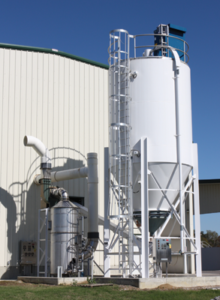
Biosolids Drying Systems for Grand Rapids Wastewater Plants
Trucking biosolids out of Grand Rapids across West Michigan adds cost with every ton, so cutting weight at the plant is where biosolids drying systems prove their worth. The RDP-Fenton wastewater sludge dryer handles work in repeating batches, letting an operator match each run to the cake solids arriving from dewatering instead of a single locked setting.
Batch sludge drying equipment rolls with those swings easily, while continuous dryers tend to buckle when the incoming feed jumps without notice. Crews say the unit asks little of them once a solid recipe is set, leaving the crew free to handle the rest of the plant.
What comes out of the dryer is far lighter and much reduced in size, trimming hauling cost and opening reuse across fertilizer, energy recovery, and soil-amendment uses throughout Michigan and the Great Lakes region. Positioned at the tail of the line, the dryer runs off the same control package as the upstream lime feed and storage gear, with one supplier behind the whole train. The design put easy operation and a long service life first, and results logged at working sites prove it out.
Learn About Fenton Drying
Ready to Discuss Your Grand Rapids Project?
Got lime feed, biosolids, or drying work on the schedule at a Grand Rapids plant? RDP Technologies can talk it through and lay out the next steps.