
Water & Wastewater Treatment Equipment Serving Charleston, SC
Precision lime feed, biosolids stabilization, drying, storage, and truck loading systems engineered by RDP Technologies for Charleston-area municipal facilities.
Trusted Process Equipment for Charleston Water & Wastewater Plants
More than four decades in, RDP Technologies still builds equipment the same way: tough, dependable, and grounded in practical technology that holds up on the job. Operators around the Lowcountry turn to RDP for accurate, weather-hardy systems that ask very little of a crew.

Lime Slaking & Feed Systems for Charleston Water Treatment Facilities
Charleston Water System pulls its drinking water from the Edisto River and the Bushy Park Reservoir, treating it at the long-running Hanahan plant before it reaches the peninsula and the surrounding Lowcountry. Coastal surface water like this leans on lime for pH correction and corrosion control, work that matters all the more where salt air and brackish influence are never far off, and RDP supplies lime slaking systems and lime feed systems tuned closely enough for that kind of careful dosing.
Load cells inside the Tekkem lime slakers for water treatment weigh a set amount of quicklime against the water, so the slaking reaction settles where the chemistry runs cleanest. Going by weight is the reason precision lime dosing systems stay accurate, letting a plant set slurry strength to exactly what pH and corrosion control call for. Even a steady coastal supply shifts a bit through the year, so reliable dosing holds the finished water right where it belongs.
Without any mechanical change, that same Tekkem rig works as a hydrated lime feed system, so Charleston can adjust as lime supply and price shift. Feed stays accurate from one dosing point to the next, carried by a recirculating slurry loop and valves that meter by the measure. Just one moving part rides inside the reaction tank, keeping upkeep light and simple to plan even where a plant runs without letup.
See the Tekkem Slaker
Biosolids Drying Systems for Charleston Wastewater Plants
Charleston sits right at the coast, where biosolids often move well inland to land-application sites, and trimming weight before they leave the plant keeps hauling cost down, which is where biosolids drying systems earn their place for Lowcountry plants. The RDP-Fenton wastewater sludge dryer cycles one batch after another, letting an operator fit each run to the cake solids arriving off dewatering instead of a fixed schedule.
Batch sludge drying equipment handles the ups and downs without strain, where continuous dryers tend to lag when the upstream feed shifts unexpectedly. Crews running it say it rarely needs attention once a workable recipe is dialed in, which leaves them free for other work.
The dried product comes out far lighter and a fraction of its former bulk, paring hauling cost and opening reuse in soil amendment, fertilizer, and energy-recovery outlets across South Carolina and the Southeast. The dryer sits last in an integrated RDP line, run off the same control scheme as the lime feed and storage gear that precedes it, the whole train backed by a single company. Simple operation and a long working life drove the design from the outset, and field data from installed sites bears that out.
Learn About Fenton Drying
Biosolids Lime Stabilization & Pasteurization Solutions in Charleston, SC
Across the Lowcountry, where low elevation and tidal reach put a premium on protecting surface waters, biosolids programs work under careful pathogen and nutrient oversight. RDP Technologies has been in lime-based work since EPA's Part 503 rules first landed, and the RDP biosolids lime stabilization line spans both grades: Class B biosolids prepared for land application, and Class A biosolids treatment when the aim is a cleaner product that travels further.
EnVessel Pasteurization ranks high among the Class A processes in use across the country, with more than 70 of them up and running. Rather than over-liming, it leans on a measured lime dose plus heat to land the time, temperature, and pH targets full pathogen kill requires, keeping reagent use modest.
When the whole process has to be closed in, Enhanced Pasteurization moves it into a sealed reactor, lime forcing pH past 12 while controlled heat completes disinfection. Both have a solid track record as wastewater pathogen reduction equipment, with a long list of installed jobs and field data to point to. For Charleston facilities sketching out their next capital round, both routes already clear SCDES and EPA.
View EnVessel Pasteurization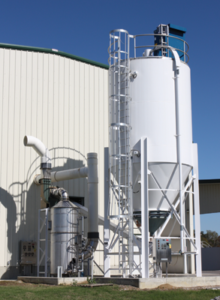
Biosolids Storage & Precision Truck Loading Systems
Out at the Plum Island plant and the other facilities Charleston Water System runs, biosolids leave the process steadily, and the loadout has to keep that pace through Lowcountry heat, humidity, and the salt that rides in off the harbor. RDP feeds biosolids storage systems into precision truck loading systems as a single run, so material gets from dewatering to loadout with nobody laying a hand on it.
A moving floor along each live bottom bin keeps damp, dense cake moving toward the outlet, where an ordinary steep-walled hopper would just bridge up and rat-hole. Pass it to the precision truck loading system and the bay carries on unattended, sludge cake filling a trailer in minutes and settling onto the operator's target weight to a tolerance of a few hundred pounds.
Hundreds of biosolids conveying equipment builds stand behind a loadout that clears trucks through quickly and cleanly with hardly a hand at the bay. Because the bay runs on its own, Charleston crews can put their hours toward work that truly needs them. For plants slammed with back-to-back hauler days, that steadiness means fewer stalls and less time on the clock for the crew.
Explore Live Bottom Bins
Custom Engineering & Process Equipment Support Serving Charleston
Charleston has been investing hard in coastal resilience, raising and rebuilding water and sewer infrastructure against sea-level rise and the tidal flooding that comes with a low-lying peninsula. Work in that setting fits RDP Technologies, which carries a custom process equipment engineering history reaching back better than four decades into the facilities Charleston Water System operates.
RDP keeps engineering, controls programming, and fabrication all in-house, so equipment can be matched to a plant's real tanks, pinched spaces, and settled crew routines instead of arriving as a stock package. Its controls slot into SCADA and put out the documentation SCDES and EPA Region 4 require of permitted facilities in South Carolina.
From early scoping all the way through fabrication, startup, and the service years that follow, RDP stays close to the municipal engineers, consulting firms, and plant operators on each project. Its measure has not moved: hardware that holds up, performance an operator can count on, and engineering grounded enough to carry its weight day to day. Be it one feed skid or an entire biosolids line, Charleston clients work through a single manufacturer that answers for the result well after the plant comes online.
Browse Technical Resources
Ready to Discuss Your Charleston Project?
Lining up lime feed, biosolids, or drying work at a Charleston plant? RDP Technologies will help you scope it and put a plan together.